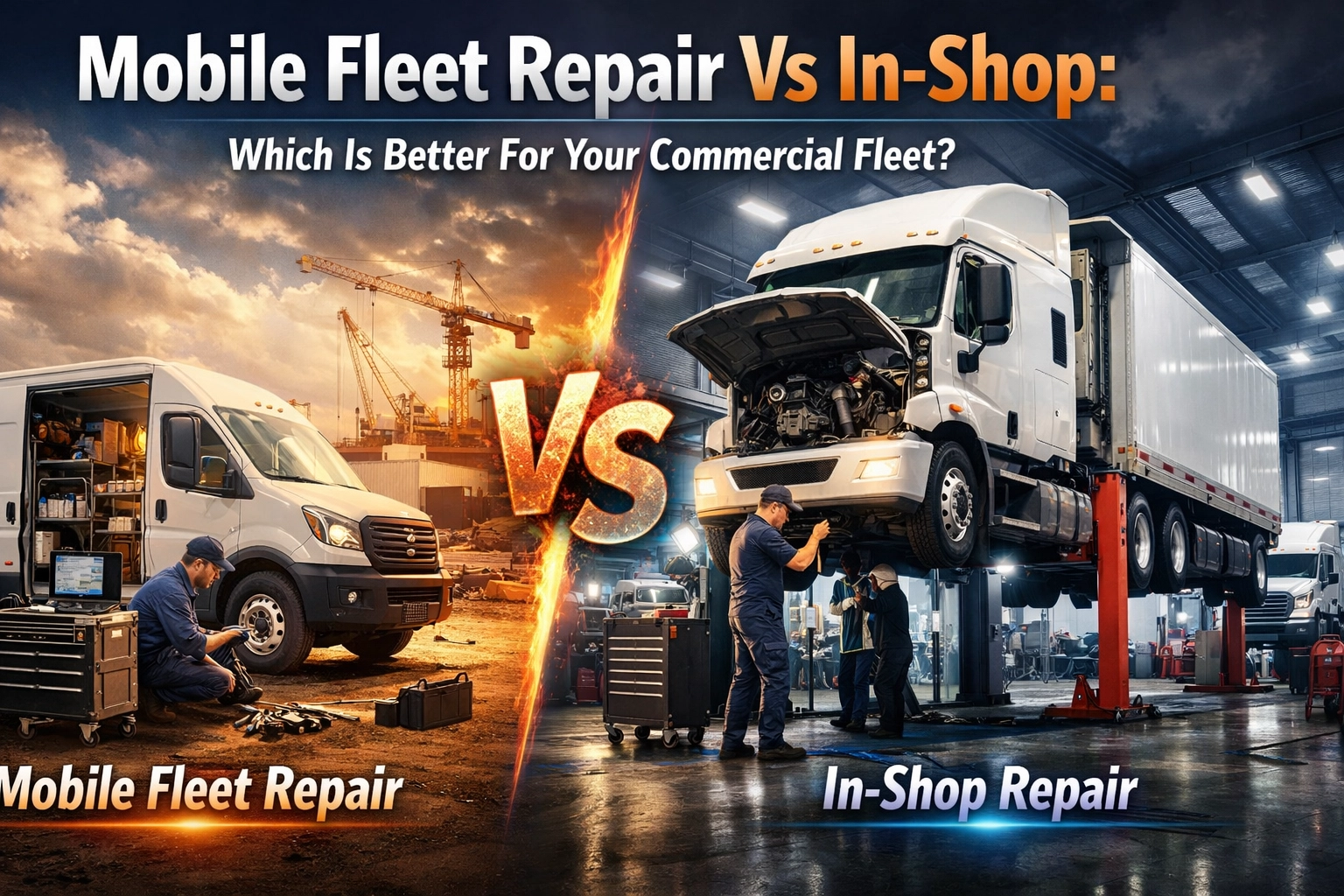
Mobile Fleet Repair Vs In-Shop: Which Is Better For Your Commercial Fleet?
For a fleet manager in the San Francisco Bay Area or Sacramento, the clock is the greatest enemy. Every minute a truck sits idle is a minute it isn’t generating revenue. When a vehicle goes down or a service interval approaches, you’re faced with a fundamental logistical question: Do you bring the truck to the shop, or do you bring the shop to the truck?
The debate between mobile fleet repair and traditional in-shop service isn’t about which one is “better” in a vacuum. It’s about which one serves your operational goals at that specific moment. At Rapid Fleet Services, we operate both high-tech mobile units and a fully equipped in-shop facility, giving us a unique perspective on how to balance these two delivery methods to keep your fleet moving.
In this guide, we’ll break down the pros, cons, and technical realities of both approaches so you can make the most cost-effective decision for your business.
Mobile Fleet Repair: The Efficiency Powerhouse
Mobile fleet repair has evolved far beyond the “guy with a toolbox in a pickup truck” stereotype. Modern mobile technicians are essentially driving self-contained workshops equipped with advanced diagnostic software, heavy-duty tools, and common replacement parts.
1. Minimize Downtime and Maximize Productivity
The primary advantage of mobile service is the elimination of transit time. When you use an in-shop service, you have to account for the time it takes to drive the vehicle to the facility, the time the driver spends waiting or getting a ride back, and the time spent retrieving the vehicle.
Mobile repair happens where your trucks are parked: whether that’s at your yard, a job site, or on the side of the I-5. This allows for “off-hours” servicing, where preventative maintenance services are performed while your drivers are sleeping, ensuring the fleet is ready to roll at dawn.
2. Eliminating the “Towing Tax”
If a vehicle is non-operable, the cost of a heavy-duty tow in the Bay Area can range anywhere from $500 to over $3,000 depending on the distance and complexity. Mobile repair units can resolve approximately 80-90% of common commercial vehicle issues on-site. By choosing mobile, you often save the entire cost of the tow, which frequently outweighs any difference in hourly labor rates.
3. Rapid Response for Emergencies
When a driver is stranded, response time is everything. Mobile units typically boast a response window of 60 to 90 minutes. Compared to the hours or even days a truck might sit in a shop’s “queue,” the mobile option is the clear winner for urgent roadside failures.

In-Shop Repair: The Heavy-Duty Powerhouse
While mobile services are incredibly convenient, there are certain mechanical realities that require the controlled environment of a professional shop. Our in-shop fleet services are designed for the “heavy lifting” that mobile units simply can’t handle safely or effectively.
1. Complex Diagnostics and System Overhauls
While mobile computers are great, some deep-system diagnostics: especially those involving DPF, EGR, and SCR after-treatment systems: benefit from the comprehensive diagnostic infrastructure of a shop. If your vehicle requires a major engine overhaul or transmission services, the shop provides the stable environment and overhead cranes necessary for such intensive labor.
2. Specialized Equipment
Certain jobs require hardware that doesn’t fit in a van. This includes heavy-duty lifts, precision alignment racks, and high-capacity air systems. For instance, detailed suspension and steering repairs often require the vehicle to be perfectly leveled on an alignment rack to ensure the work meets OEM specifications.
3. Controlled Environment for Precision Work
Weather in Northern California is generally fair, but heavy rain or extreme heat can impact the quality of certain repairs. A shop provides a climate-controlled environment where technicians can perform precision work without the interference of wind, dust, or moisture. This is particularly important for electrical system maintenance and sensitive sensor calibrations.

Comparing the Costs: A Strategic Breakdown
When deciding between mobile and in-shop, don’t just look at the hourly rate. Look at the Total Cost of Repair (TCR).
| Factor | Mobile Repair | In-Shop Repair |
|---|---|---|
| Labor Rate | Often slightly higher to cover overhead. | Competitive base rates. |
| Towing Costs | $0 (in most cases). | $500 – $3,000+. |
| Downtime Cost | Minimal (Vehicle stays on-site). | High (Transit + Queue time). |
| Driver Labor | $0 (No driver needed for transport). | 2-4 hours of paid driver time. |
| Success Rate | 80-90% for common issues. | 100% for all repair types. |
A typical day of downtime for a commercial vehicle can cost a company between $400 and $700 in lost revenue. If a mobile technician can get that truck back on the road four hours faster than a shop could, the mobile service has already paid for itself, even if the labor rate was higher.
When to Call for Mobile vs. When to Book the Shop
To help you streamline your operations, here is a prescriptive guide on how to categorize your fleet needs:
Choose Mobile Fleet Repair For:
- Preventative Maintenance: Oil and filter changes, engine health checks, and fluid top-offs.
- DOT and BIT Inspections: Keeping your fleet compliant without leaving the yard. Check out our DOT/BIT inspection services for more details.
- Brake Issues: Most brake failures and maintenance can be handled on-site.
- Electrical Systems: Swapping batteries, starters, or alternators.
- Light-to-Medium Repairs: Belts, hoses, and cooling system leaks.
Choose In-Shop Service For:
- Major Engine Work: Head gaskets, turbo replacements, or full engine swaps.
- Transmission Rebuilds: Intensive fleet transmission inspections that require component removal.
- Frame and Structural Repair: Anything requiring heavy welding or structural alignment.
- Complex Electronic Gremlins: When multiple systems are failing and require extended diagnostic “soak time.”

The Rapid Fleet Services Advantage: The Hybrid Approach
We don’t believe fleet managers should have to choose just one provider. The most successful fleets in the SF Bay Area and Sacramento utilize a hybrid strategy. They use our mobile units for 90% of their preventative maintenance and minor repairs, keeping their trucks in the field and their drivers productive. When a major component fails or a complex diagnostic issue arises, they transition the vehicle to our specialized shop.
This “Best of Both Worlds” approach ensures:
- Reliability: You have a single point of contact who knows your fleet’s history, whether they are working on it in your yard or in our shop.
- Accountability: No more finger-pointing between the “mobile guy” and the “shop guy.”
- Speed: If a mobile technician realizes a job is too big for the field, we can immediately prioritize a bay in our shop to get it moved and fixed.
Keep Your Fleet Moving
Whether you are managing a dozen delivery vans in San Francisco or a fleet of heavy-duty haulers in Sacramento, your goal is the same: maximum uptime.
Rapid Fleet Services is built to support that goal. By offering both elite mobile capabilities and a robust in-shop facility, we provide the flexibility you need to handle any mechanical challenge that comes your way.
Don’t let a breakdown dictate your schedule. Take a proactive approach to your fleet’s health. If you’re ready to see how a professional, dual-approach repair strategy can lower your costs and keep your trucks on the road, contact us today. Our team is ready to provide the mechanical expertise and operational reliability your business deserves.
Comments are closed